
Chandrayaan-4 — India’s Next Big Step Toward the Moon
When Chandrayaan-3 successfully landed near the Moon’s south pole in August 2023, it became one of the most important moments in India’s space history. The mission proved that the Indian Space Research Organisation, better known as ISRO, could safely land a spacecraft on one of the most difficult regions of the Moon.
The Vikram lander and Pragyan rover studied the lunar surface, confirmed the presence of sulfur near the south pole, and collected valuable scientific data. But Chandrayaan-3 was not the end of India’s lunar
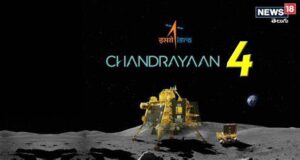
journey. In many ways, it became the foundation for an even more ambitious mission — Chandrayaan-4.
Unlike Chandrayaan-3, which mainly focused on landing and surface exploration, Chandrayaan-4 aims to do something much more difficult: bring lunar soil and rock samples back to Earth. Only a few countries have successfully achieved a lunar sample return mission, and ISRO now wants India to join that group.
Basic Information About Chandrayaan-4
Chandrayaan-4 is currently planned as a lunar sample-return mission. According to ISRO officials, the mission is expected to launch around 2027 or 2028, though the exact launch date has not yet been officially finalized. (Gadgets 360)
The mission will likely launch from the Satish Dhawan Space Centre at Sriharikota, the same launch center used for Chandrayaan-3. ISRO plans to use the powerful Launch Vehicle Mark-3, also known as LVM3, along with additional launch support because the mission is too complex for a single spacecraft launch. (RocketLaunch.org)
The mission concept has been discussed under the leadership of former ISRO chairman S. Somanath and current ISRO scientists working on India’s future lunar exploration program. Scientists such as Nilesh M. Desai have also spoken publicly about the project and its technology plans. (Wikipedia)
One interesting fact about Chandrayaan-4 is that it may involve multiple spacecraft modules working together in lunar orbit. This makes it one of the most technically advanced missions ever attempted by India.
The Vision and Main Objectives
The biggest goal of Chandrayaan-4 is simple to understand but extremely difficult to achieve: land on the Moon, collect samples from the lunar surface, and safely return them to Earth. (India Today)
Scientists are especially interested in the Moon’s south polar region because it may contain water ice trapped inside permanently shadowed craters. Water on the Moon is important not only for science but also for future human missions. It could potentially be used for drinking water, oxygen production, or even rocket fuel in the future.
The mission is also expected to help India develop technologies needed for future human lunar missions. ISRO has already stated that Chandrayaan-4 will test advanced systems related to docking, robotic operations, lunar ascent, and Earth re-entry. (Wikipedia)
In simple terms, Chandrayaan-4 is not just about collecting Moon rocks. It is also about preparing India for deeper space exploration in the coming decades.
Equipment and Technology Used
Chandrayaan-4 is expected to be much more complex than Chandrayaan-3 because it involves several stages.
Reports suggest the mission may include:
- A Descender Module for landing on the Moon
- An Ascender Module that will lift off from the Moon carrying samples
- A Transfer Module operating in lunar orbit
- A Re-entry Module that will bring the samples back to Earth
- A Propulsion Module for guiding the spacecraft during different mission stages (RocketLaunch.org)
One of the most challenging parts will be robotic sample collection. ISRO is developing robotic arms and drilling systems capable of collecting lunar soil, also called regolith. (Wikipedia)
Another major technology is space docking. After collecting samples, one spacecraft module may need to dock with another spacecraft in lunar orbit before returning to Earth. ISRO considers this a critical technology for future missions. (Wikipedia)
The mission will also require advanced navigation systems, autonomous landing software, high-capacity propulsion systems, and safe atmospheric re-entry technology so the lunar samples can survive the journey back home.
Compared to earlier Chandrayaan missions, this mission combines landing, sample collection, ascent from the Moon, orbital docking, and Earth return in a single project. That is why many scientists describe it as India’s most challenging lunar mission so far.
Why Chandrayaan-4 Matters
Space exploration is often measured not only by how far a spacecraft travels, but by what new abilities a country develops along the way. Chandrayaan-4 represents the next stage of India’s growing confidence in deep-space science and engineering.
The Moon still holds many unanswered questions about the early Solar System, volcanic activity, and the possibility of usable resources. By bringing samples back to Earth, scientists can study lunar material in far greater detail than remote instruments allow.
At the same time, missions like Chandrayaan-4 inspire students, researchers, and young engineers who dream of contributing to future space exploration.
After Chandrayaan-3 showed that India could land safely on the Moon, Chandrayaan-4 now asks a bigger question: can India complete one of the most difficult tasks in modern space science and bring part of the Moon back to Earth?
The answer may shape the future of India’s space program for decades to come.