
In the previous blog, we explored the Sun—how it formed from a giant cloud of gas around 4.6 billion years ago, how nuclear fusion powers it, and how its layers work together to produce the light and heat that make life on Earth possible. We also looked at the Sun’s anatomy, from its extremely hot core to its outer atmosphere, the corona.
Among the many questions people ask about the Sun, one stands out because it sounds both fascinating and alarming: What if the Sun suddenly turned into a black hole?
It is a question that combines two of the most interesting objects in astronomy—a star and a black hole. The idea may sound like science fiction, but it actually gives us an opportun
ity to understand how stars evolve and what conditions are required to create a black hole in the first place.
How Does a
Star Become a Black Hole?
A black hole does not appear out of nowhere. It forms during the final stages of the life of a very massive star.
Throughout most of a star’s life, gravity tries to pull its material inward while nuclear fusion pushes outward. These two forces remain in balance for millions or billions of years. Eventually, however, the star runs out of fuel. Without enough outward pressure, gravity begins to win.
For stars that are several times more mass
ive than our Sun, the core can collapse under its own gravity after a powerful supernova explosion. If enough mass remains in the core, it can compress into an incredibly small region known as a black hole.
Black holes have several remarkable characteristics:
- Gravity so strong that not even light can escape.
- An outer boundary called the e
- vent horizon, beyond which escape is impossible.
- Extremely dense matter packed into a very small volume.
- The ability to bend space and time according to Einstein’s theory of relativity.
- Detection through their effects on nearby stars, gas, and light rather than direct observation.
Despite their reputation, black holes
are not cosmic vacuum cleaners. They pull on surrounding objects through gravity just like any other object with the same mass.
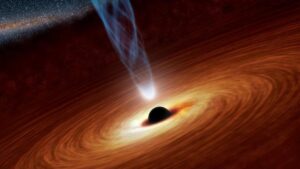
Could the Sun Ever Become a Black Hole?
The simple answer is no.
The Sun does not have enough mass to become a black hole. Astronomers estimate that a star generally needs to begin its life with at least about 20 times the Sun’s mass to eventually form a black hole.
Our Sun is considered a medium-sized star. It has enough mass to sustain nuclear fusion, but not enough to experience the catastrophic collapse needed for black hole formation.
Instead, the Sun will follow a different path.
About 5 billion years from now, the hydrogen fuel in its core will become depleted. The Sun will expand into a Red Giant, growing so large that it may engulf Mercury and Venus and significantly affect Earth.
After this phase, the Sun will shed its outer layers into space, creating a beautiful glowing shell called a planetary nebula. The remaining core will become a White Dwarf, a dense Earth-sized stellar remnant that will slowly cool over billions of years.
So while the Sun’s future is dramatic, it does not include becoming a black hole.
What If the Sun Somehow Instantly Became a Black Hole?
Although nature will not allow this to happen, imagining it helps reveal something surprising.
Suppose the Sun magically transformed into a black hole while keeping exactly the same mass.
Most people expect Earth to be pulled into it immediately. In reality, that would not happen.
Because the mass remains unchanged, the gravitational pull on Earth would also remain unchanged. Our planet would continue orbiting the black hole just as it currently orbits the Sun.
The real problem would be the loss of sunlight.
About 8 minutes and 20 seconds after the transformation, Earth would stop receiving light and heat. Temperatures would begin falling rapidly. Photosynthesis would cease, ecosystems would collapse, and the planet would gradually become a frozen world.
The black hole itself would be surprisingly small. A black hole containing the Sun’s mass would have an event horizon only about 6 kilometers across—tiny compared with the Sun’s current diameter of nearly 1.4 million kilometers.
Understanding the Difference Between Possibility and Reality
Questions like this are valuable because they highlight how astronomy works. Not every imaginable scenario is physically possible, but exploring such ideas helps us understand the laws governing stars and the universe.
The Sun’s actual future is well understood. Rather than collapsing into a black hole, it will spend billions of years gradually evolving through the Red Giant and White Dwarf stages. That long timeline gives life on Earth plenty of time before solar evolution becomes a serious concern.
Yet the Sun still has many mysteries left to reveal. One of the most intriguing involves its magnetic activity, which can produce powerful eruptions known as solar flares. These events can affect satellites, communication systems, and even power grids on Earth.
So while the Sun will never become a black hole, it remains an active and dynamic star whose behavior continues to shape our technological world. In the next blog, we will explore solar flares and discover how disturbances on the surface of the Sun can have consequences millions of kilometers away here on Earth.