
Coronal Mass Ejections: When the Sun Throws Part of Its Atmosphere Into Space
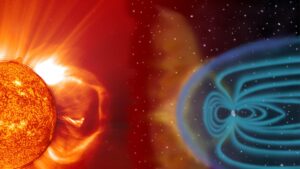
The Sun is often described as a giant ball of hot gas, but it is much more active than that. Its surface and atmosphere are constantly shaped by powerful magnetic fields that twist, stretch, and sometimes snap. When this happens on a large scale, the Sun can hurl enormous clouds of charged particles into space. These events are known as Coronal Mass Ejections (CMEs).
Unlike sunlight, which reaches Earth in about eight minutes, a CME takes much longer to arrive. It travels through space carrying billions of tons of solar material and powerful magnetic energy. Most CMEs miss Earth completely, but when one is directed toward our planet, it can affect satellites, communications, navigation systems, and even power grids.
How and Where Does a CME Form?
A Coronal Mass Ejection originates in the Sun’s outer atmosphere, known as the corona. The corona is the faint, superheated layer that extends millions of kilometers into space and becomes visible during a total solar eclipse.
The main driver behind a CME is the Sun’s magnetic field. The Sun does not rotate as a solid object; different regions rotate at different speeds. Over time, this motion twists and tangles magnetic field lines in the corona.
When enough magnetic energy builds up, the field can suddenly reorganize itself through a process called magnetic reconnection. This releases a tremendous amount of energy and launches a massive cloud of plasma—consisting mainly of electrons and protons—into space.
The formation process usually follows these stages:
- Magnetic fields become twisted and stressed.
- Energy accumulates in the corona.
- Magnetic reconnection occurs.
- A giant cloud of plasma erupts outward.
- The CME travels through the Solar System.
CMEs vary greatly in speed. Slow events may move at around 250 kilometers per second, while the fastest can exceed 3,000 kilometers per second. Depending on their speed, they typically take 15 hours to several days to reach Earth.
The Two Most Recent Notable CMEs
The May 2024 Solar Storm
One of the most significant recent CME events occurred in May 2024. A highly active sunspot region produced multiple powerful eruptions that combined into a major geomagnetic storm.
The storm reached G5 level, the strongest category on the geomagnetic storm scale. Auroras became visible much farther from the poles than usual, appearing across parts of Europe, Asia, and North America. Some satellite operators and communication systems experienced temporary disruptions, but the event also provided scientists with valuable data about space weather.
The June 2025 Earth-Directed CME
In June 2025, another notable Earth-directed CME was observed. Space weather agencies monitored the eruption closely because of its potential impact on satellites and radio communications. While its effects were less severe than the May 2024 storm, it demonstrated that the Sun remains highly active during the current solar cycle and that continuous monitoring is essential.
The Most Powerful CME Ever Recorded
When discussing extreme CMEs, scientists often point to the Carrington Event of 1859.
Astronomer Richard Carrington observed an intense solar flare shortly before Earth was struck by an exceptionally powerful CME. At the time, modern electrical technology barely existed, yet the effects were dramatic.
Telegraph systems failed across several countries. Some operators received electric shocks, and telegraph equipment reportedly continued working even after being disconnected from power sources. Auroras were seen so far from the poles that people in tropical regions could observe them.
How Do CMEs Affect Earth and Living Beings?
Positive Effects
CMEs are not entirely bad.
One of their most beautiful effects is the creation of auroras, commonly known as the Northern and Southern Lights. When charged particles from a CME interact with Earth’s magnetic field and atmosphere, colorful curtains of light appear in the sky.
CMEs also help scientists study:
- The Sun’s magnetic field
- Space weather forecasting
- Earth’s magnetosphere
- Solar activity cycles
Understanding these events improves our ability to protect technological systems in the future.
Negative Effects
When a strong CME reaches Earth, it can produce geomagnetic storms that affect technology.
Potential consequences include:
- Disruption of satellite operations
- GPS navigation errors
- Radio communication interruptions
- Increased radiation exposure for astronauts
- Power grid disturbances
For people on the ground, Earth’s magnetic field and atmosphere provide excellent protection. Therefore, CMEs do not directly harm most living organisms at Earth’s surface.
However, astronauts in space and passengers on high-altitude polar flights may experience increased exposure to energetic particles during major solar events.
A Brief Ending
Coronal Mass Ejections remind us that Earth is not isolated from the rest of the Solar System. Our planet exists within a dynamic environment shaped by the activity of the Sun. Most of the time, Earth’s magnetic field shields us from these solar outbursts, but powerful CMEs can still influence the technologies we depend on every day.
As solar observatories continue to monitor the Sun, scientists are getting better at predicting these events. The more we learn about CMEs, the better prepared we become for the next giant cloud of solar material heading our way.